
Introduction
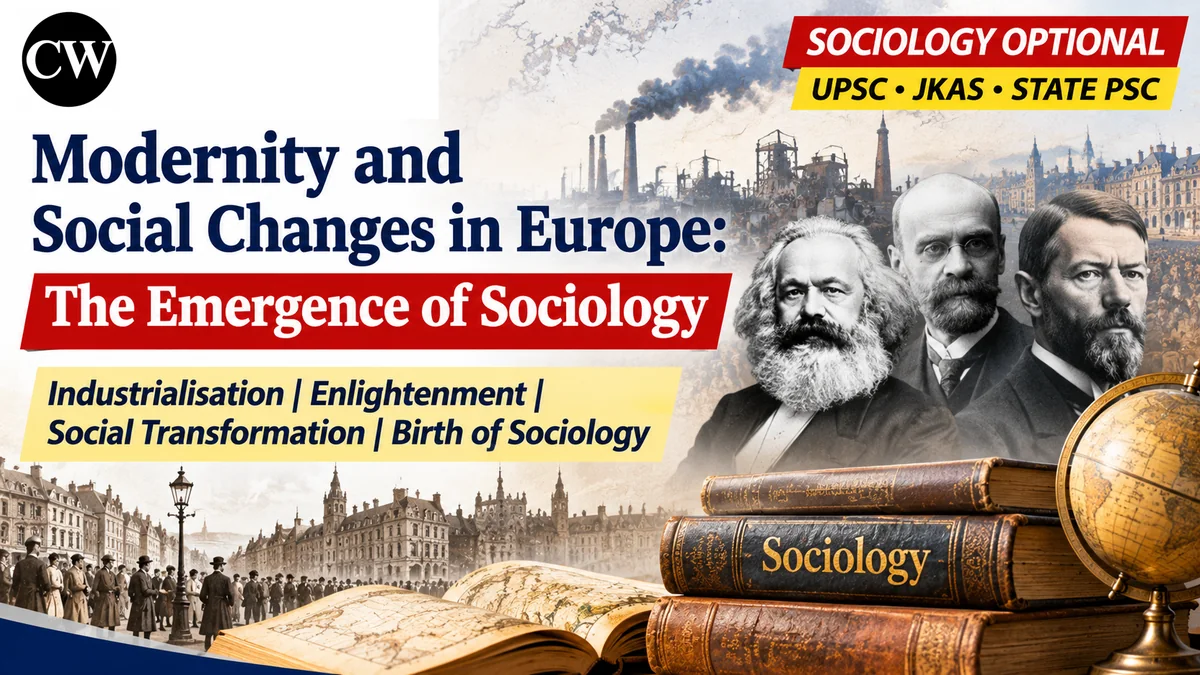
Sociology did not emerge independently of the historical conditions of society. It developed in nineteenth-century Europe during a period of profound intellectual, political, economic and social transformation. Established patterns of authority, economic production, social relationships and collective life were being questioned and reorganised. The transition from predominantly agrarian and hierarchical social arrangements towards industrial capitalism, modern political institutions and increasingly urban societies created new conditions that demanded systematic explanation.
For centuries, European social life had been influenced by land-based production, inherited social hierarchies, religious authority and local communities. However, the expansion of scientific knowledge, the growth of commerce, the questioning of traditional authority, political revolutions and industrialisation gradually transformed this social order. The individual increasingly came to be recognised as a bearer of rights, political authority was redefined, economic production became increasingly organised around markets and industrial enterprises, and cities expanded. These changes were neither uniform nor simultaneous. Traditional institutions continued to exist, often interacting with emerging modern arrangements.
The emergence of Sociology was closely connected with the intellectual need to understand these transformations. The Scientific Revolution encouraged systematic investigation of the natural world, while the Enlightenment extended critical reasoning to political and social institutions. The French Revolution challenged inherited political authority and advanced new ideas of citizenship and equality. The Industrial Revolution transformed production, labour relations and class structures. The expansion of capitalism and urbanisation generated new forms of inequality, social conflict and changes in community life.
These developments created a new set of questions. What holds society together when traditional authority weakens? Why does economic progress coexist with poverty and inequality? How do political and economic institutions shape individual behaviour? What produces social stability, conflict and historical change?
Sociology emerged as a systematic attempt to investigate such questions. Its early thinkers approached modern society from different perspectives. Henri de Saint-Simon contributed to the intellectual foundations of a science of society; Auguste Comte sought to establish Sociology as a scientific discipline; Harriet Martineau developed systematic methods of social observation; Karl Marx examined capitalism and class conflict; Émile Durkheim investigated social solidarity and integration; and Max Weber analysed social action, rationalisation and modern authority.
Understanding the emergence of Sociology therefore requires more than memorising a sequence of historical events or the names of classical thinkers. It requires examining how intellectual developments and social transformations interacted to create both the need and the possibility for a systematic study of society.
Learning Dashboard
| Learning Dimension | What You Will Understand |
|---|---|
| Historical context | Traditional European society and the gradual transition towards modernity |
| Intellectual transformation | The Renaissance, Scientific Revolution and Enlightenment and their distinct contributions |
| Political transformation | How the French Revolution challenged inherited authority and transformed citizenship |
| Economic transformation | The historical development of capitalism and the expansion of industrial production |
| Social transformation | Industrialisation, urbanisation, migration, class formation and changing community relationships |
| Early social thinkers | The contributions of Saint-Simon, Comte and Harriet Martineau |
| Classical Sociology | The different concerns of Marx, Durkheim and Weber |
| Institutional development | How Sociology became an organised academic discipline |
| Central sociological questions | The relationship between social order, social integration, conflict and change |
| UPSC relevance | How to analyse the historical and intellectual foundations of Sociology |
1. Understanding Modernity: From Traditional Society to Modern Society
Modernity refers to a broad historical and social transformation associated with the development of industrial economies, capitalist relations, modern political institutions, scientific knowledge, urbanisation, bureaucratic administration and new forms of individual and collective life. It is not simply another term for the present period. Rather, it describes a distinctive set of social arrangements and processes that developed unevenly across different societies.
In Europe, the transition towards modernity involved a gradual transformation of institutions that had organised social life for centuries. Land-based production, feudal relationships, inherited privileges and the influence of religious institutions were increasingly challenged by commercial expansion, industrial production, centralised states, scientific thinking and new political ideas.
1.1 Characteristics of Traditional European Society
Before the consolidation of modern industrial society, much of Europe was predominantly agrarian. Land was a principal source of wealth and livelihood, and agricultural production formed the foundation of economic life. A large proportion of the population lived in villages and depended directly or indirectly on agriculture.
Social relationships were strongly influenced by inherited status, family background, religious affiliation and customary obligations. Feudal arrangements, although varying across regions and historical periods, structured relationships between landholding elites and dependent cultivators. Access to land, political influence and social privileges were unequally distributed.
Religion occupied a central position in intellectual and institutional life. The Church exercised considerable influence over education, morality and public authority in many parts of Europe. Religious institutions also helped shape ideas about political legitimacy, social obligations and the moral organisation of society.
Social mobility was generally more restricted than it would become in modern industrial societies. Birth and inherited position significantly influenced an individual’s social opportunities. Local communities, kinship relationships and customary practices provided important sources of social identity, belonging and support.
However, traditional European society should not be understood as completely static or uniform. Commercial networks, towns, universities, intellectual movements and political changes existed well before industrialisation. The expansion of trade and financial activity also created economic relationships that gradually weakened the exclusive importance of land-based wealth.
The transition towards modernity was therefore a long and uneven historical process rather than a sudden replacement of one social system by another.
1.2 The Transition Towards Modernity
The emergence of modern society involved changes across several interconnected dimensions.
| Dimension | Traditional Social Arrangements | Emerging Modern Arrangements |
|---|---|---|
| Economy | Predominantly agrarian and land-based production | Expanding commercial, industrial and capitalist production |
| Social organisation | Strong influence of inherited status and customary relationships | Growing importance of class, occupation, education and economic position |
| Political authority | Monarchical, dynastic and religiously legitimised authority | Constitutional government, citizenship and modern state institutions |
| Knowledge | Strong influence of religious and inherited explanations | Increasing importance of scientific inquiry and rational criticism |
| Social relationships | Local communities, kinship and customary obligations | Expanding contractual, occupational and impersonal relationships |
| Settlement patterns | Predominantly rural population | Increasing urbanisation and industrial towns |
| Social mobility | Relatively restricted opportunities shaped by inherited position | Expanding, though unequal, opportunities through education, occupation and economic activity |
The table represents broad historical tendencies, not a universal or complete transformation. Traditional institutions continued to influence modern European societies, while modern institutions developed at different rates across countries.
The significance of this transition lies in the fact that the foundations of social life themselves became subjects of questioning. Why do societies maintain order? What produces inequality? How does industrial production transform relationships between individuals? What holds a society together when traditional sources of authority weaken? These questions became central to the development of sociological thought.
2. Intellectual Transformations: The Foundations of Modern Social Thought
The emergence of Sociology was not only a consequence of political and economic change. It was also made possible by a major transformation in the ways Europeans understood knowledge, reason, human beings and society.
Three developments are particularly important: the Renaissance, the Scientific Revolution and the Enlightenment. They were historically interconnected but distinct intellectual developments. The Renaissance encouraged renewed engagement with human life and classical learning; the Scientific Revolution transformed methods of investigating nature; and the Enlightenment extended the application of reason and critical inquiry to questions of politics, society and human institutions.
2.1 The Renaissance: Renewed Interest in Human Life and Knowledge
The Renaissance, which developed in parts of Europe from approximately the fourteenth century onwards, marked a significant revival of interest in classical Greek and Roman learning, literature, art and philosophy. It encouraged new forms of intellectual curiosity and placed greater emphasis on human creativity, education and individual achievement.
Humanism was an important intellectual feature of the Renaissance. It encouraged the study of human experience, classical texts, moral questions and the capacities of human beings. This did not mean that Renaissance thinkers simply rejected religion. Rather, it expanded the range of intellectual interests and encouraged a renewed engagement with human life and the world.
The Renaissance contributed to the broader intellectual climate in which the individual, human reason and worldly experience received greater attention. Its importance for the emergence of Sociology was indirect: it helped prepare the ground for later transformations in scientific thought and social philosophy.
Sociological significance: The Renaissance contributed to the expansion of intellectual inquiry and the growing interest in human capacities and social life. This broader intellectual environment later supported systematic reflection on society.
2.2 The Scientific Revolution: The Rise of Systematic Inquiry
The Scientific Revolution, particularly from the sixteenth and seventeenth centuries, transformed European understandings of nature and the physical universe. Thinkers such as Nicolaus Copernicus, Galileo Galilei and Isaac Newton contributed to explanations based on observation, mathematical reasoning and systematic investigation.
The significance of this transformation extended beyond discoveries in astronomy and physics. It strengthened the belief that natural phenomena could be investigated through systematic methods rather than explained solely through inherited authority or speculation.
The success of modern natural science encouraged intellectuals to consider whether human behaviour and social institutions could also be studied systematically. If nature operated through discoverable patterns and regularities, could society also be examined to identify patterns of social organisation, conflict and change?
This question became important for the development of Sociology. However, studying society is not identical to studying the physical world. Human beings interpret their actions, respond to social conditions and participate in creating the institutions that shape their lives. Consequently, Sociology developed methods and perspectives suited to the distinctive character of social reality.
Sociological significance: The Scientific Revolution contributed to the belief that knowledge should be supported by systematic investigation, reason and evidence. It helped establish the intellectual foundations for the later ambition to study society scientifically.
2.3 The Enlightenment: Reason, Progress and Criticism of Traditional Authority
The Enlightenment was a major intellectual movement of seventeenth- and eighteenth-century Europe, particularly influential during the eighteenth century. It emphasised reason, critical inquiry, human improvement, intellectual freedom and the possibility of reforming social and political institutions.
The Scientific Revolution and the Enlightenment were closely connected, but they were not identical. The Scientific Revolution primarily transformed methods of investigating the natural world through observation, experimentation and mathematical reasoning. Its achievements strengthened confidence in the power of human reason and systematic knowledge. Enlightenment thinkers extended this intellectual confidence to the study of human society, political authority, law, morality and economic institutions.
In this sense, scientific developments helped establish the intellectual conditions for Enlightenment rationalism, while Enlightenment thought extended critical reasoning beyond nature to the organisation of society.
Enlightenment thinkers questioned the unquestioned acceptance of inherited authority and encouraged the examination of institutions through rational argument. They increasingly treated society as a human creation that could be understood, criticised and reformed.
Several thinkers made important contributions to this intellectual transformation.
| Thinker | Major Contribution | Relevance to Modern Social Thought |
|---|---|---|
| John Locke | Natural rights, consent and limitations on political authority | Strengthened arguments for individual rights and legitimate government |
| Montesquieu | Comparative analysis of political institutions and separation of powers | Encouraged systematic comparison of political and social arrangements |
| Voltaire | Criticism of intolerance and arbitrary authority | Strengthened intellectual criticism and religious toleration |
| Jean-Jacques Rousseau | Popular sovereignty and the social contract | Influenced debates on political legitimacy and collective authority |
| Denis Diderot | Promotion of knowledge and intellectual inquiry through the Encyclopédie | Contributed to the wider circulation of knowledge |
| Mary Wollstonecraft | Criticism of women’s unequal position and advocacy of women’s education | Extended critical reasoning to gender relations and social inequality |
The Enlightenment encouraged the idea that social institutions were not necessarily natural, permanent or beyond criticism. Political authority could be examined, inequality could be questioned and social arrangements could be evaluated according to principles of reason and justice.
This intellectual climate also strengthened the belief in progress. Human society was increasingly viewed as capable of transformation through knowledge, education and institutional reform.
However, the Enlightenment was not a single unified philosophy. Its thinkers differed on political authority, religion, property, equality and the nature of human society. Nor did Enlightenment ideals automatically produce democratic or egalitarian outcomes. Their historical significance lies in the expansion of critical reasoning and the questioning of established social arrangements.
Sociological significance: The Enlightenment provided an intellectual foundation for Sociology by encouraging the systematic study of society, the critical examination of institutions and the search for rational explanations of social order and change.
3. Political Transformation: The French Revolution and the Reorganisation of Society
The French Revolution of 1789 was a decisive political transformation in European history. It challenged the established political and social order of France, particularly the privileges of the monarchy, aristocracy and clergy, and advanced ideas of citizenship, popular sovereignty and legal equality.
Before the Revolution, French society was organised under the Ancien Régime, a system characterised by monarchical authority and legally recognised social privileges. Society was conventionally divided into three estates: the clergy, the nobility and the Third Estate, which included the vast majority of the population, from peasants and urban workers to sections of the middle class.
The unequal distribution of privileges, fiscal pressures, economic hardship, political dissatisfaction and the influence of Enlightenment ideas contributed to the revolutionary crisis.
3.1 Major Political and Social Changes
The Revolution challenged the legitimacy of absolute monarchy and promoted the principle that political authority should be grounded in the nation rather than merely inherited through dynastic succession.
The Declaration of the Rights of Man and of the Citizen, adopted in August 1789, articulated principles of liberty, legal equality, national sovereignty and individual rights. The Revolution also weakened the institutional privileges of the old social order and contributed to the reorganisation of political and administrative structures.
Its broader implications included:
First, the transformation of political authority. The traditional claim that rulers possessed authority through hereditary and divine legitimacy was challenged by the principle of popular sovereignty. Political legitimacy increasingly became associated with the nation and its citizens.
Second, the weakening of inherited privilege. The Revolution attacked the legal privileges associated with the old estates and advanced the principle of equality before the law. This did not eliminate economic inequality, but it transformed the basis on which political and legal status was justified.
Third, the emergence of modern citizenship. Individuals increasingly came to be understood as members of a political community possessing rights and obligations, rather than merely as subjects of a monarch. Citizenship became an important basis for defining the relationship between individuals and the modern state.
Fourth, the spread of nationalism and modern political ideas. Revolutionary developments contributed to the expansion of debates on nationhood, citizenship, constitutional government and popular participation across Europe.
3.2 The Sociological Significance and Limitations of Revolutionary Equality
The French Revolution was important for Sociology because it made the problem of social and political order particularly visible.
The Revolution demonstrated that political institutions and established hierarchies were historically created arrangements rather than necessarily permanent features of social life. It also raised questions about what holds a society together when inherited sources of authority are challenged.
The revolutionary period generated both hope and anxiety. On one hand, it advanced ideas of liberty, equality and citizenship. On the other, political instability, violence and conflict raised concerns about the conditions necessary for social cohesion.
However, the revolutionary ideals of universal liberty and equality were not translated into equal political and social rights for everyone. Women remained excluded from full political citizenship, despite their participation in revolutionary events and the articulation of demands for equal rights. Olympe de Gouges, for example, challenged this exclusion through her Declaration of the Rights of Woman and of the Female Citizen (1791). The persistence of slavery and colonial inequalities also exposed the contradictions between universal declarations of human rights and their actual application. Although revolutionary France abolished slavery in its colonies in 1794, Napoleon restored it in 1802 in territories where it had been abolished, demonstrating the contested and uneven character of revolutionary equality.
These limitations are sociologically significant because they show that universal principles can coexist with institutional exclusions and unequal power relations. Formal declarations of equality do not automatically eliminate social hierarchies or guarantee equal access to rights.
These tensions became central to early sociological thought. Auguste Comte was particularly concerned with rebuilding intellectual and moral order in a society experiencing rapid transformation. Émile Durkheim later examined the conditions under which solidarity could be maintained in increasingly differentiated modern societies. Marx, by contrast, directed attention towards the structural inequalities and class conflicts that accompanied modern economic and political arrangements.
Sociological significance: The French Revolution brought questions of political legitimacy, social hierarchy, citizenship, equality and social order to the centre of modern social thought. Its limitations also demonstrated the gap between universal political ideals and unequal social realities.
4. Economic Transformation: Capitalism, Industrialisation and the Rise of Industrial Society
The Industrial Revolution, which began in Britain during the second half of the eighteenth century and spread to other parts of Europe during the nineteenth century, transformed the organisation of economic production.
It involved the expansion of machine-based manufacturing, factory production, new sources of energy, technological innovation and changes in the organisation of labour. Production increasingly shifted from small-scale, household and workshop arrangements towards larger industrial establishments.
However, capitalism and industrialisation should not be treated as identical or as processes that originated simultaneously. Commercial capitalism and market-oriented economic activity developed before the full-scale Industrial Revolution. Industrialisation subsequently transformed and greatly expanded capitalist production.
4.1 The Historical Development of Capitalism
Capitalism developed gradually through changes in trade, finance, ownership, production and market relationships. Long-distance commerce, merchant networks, banking, credit arrangements and the expansion of markets contributed to the growth of commercial capitalism in Europe before the establishment of the modern factory system.
From the late medieval and early modern periods, expanding trade networks connected European markets with wider regions of the world. Merchant capital became increasingly important, while financial institutions and commercial enterprises supported the expansion of economic activity. Colonial expansion and overseas trade also contributed to the accumulation of wealth and the development of European commercial power, although these processes were accompanied by coercion, dispossession and exploitation.
In parts of Europe, changes in agricultural production, landholding and labour arrangements further contributed to the development of market-oriented economic relations. The putting-out system, in which merchants supplied raw materials to household producers and organised the sale of finished goods, was one example of production becoming increasingly connected with commercial capital before large-scale factory industrialisation.
The Industrial Revolution did not create capitalism from nothing. Rather, it transformed an already developing commercial and market economy by expanding mechanised production, factory organisation, wage labour and investment in industrial enterprises.
4.2 The Industrial Revolution: From Agrarian to Industrial Production
Before industrialisation, economic activity in much of Europe was predominantly based on agriculture, handicrafts and small-scale production. Manufacturing often took place in households or workshops, and production was closely connected with local markets and traditional skills.
Industrialisation expanded mechanised production and concentrated workers, machines and capital in factories. The factory system introduced new forms of labour discipline, supervision, time management and specialisation.
The expansion of industrial production increased the importance of wage labour. A growing section of the population depended on selling its labour for wages rather than directly controlling the means of production or relying primarily on agricultural livelihoods.
This transformation contributed to the growth of new social classes and altered the structure of economic power.
4.3 The Growth of Industrial Capitalism
Industrial capitalism became a central feature of modern industrial society. It involved the expansion of private ownership of productive resources, production for markets, investment of capital, wage labour and the pursuit of profit.
Industrial capitalism reorganised economic relationships. Factory owners and investors controlled productive resources, while workers increasingly depended on wages for their livelihood.
This produced new forms of economic opportunity, but also generated inequalities in ownership, income, working conditions and control over production.
The relationship between capital and labour became a central concern of classical Sociology, particularly in the work of Karl Marx.
Marx argued that capitalist society was structured by a fundamental conflict between the bourgeoisie, who owned and controlled the means of production, and the proletariat, who depended on selling their labour power. He examined how economic relations shaped class structure, exploitation and social conflict.
4.4 Changing Nature of Work
Industrialisation transformed the organisation and experience of work.
In many pre-industrial settings, work was closely connected with agricultural seasons, household production and local community life. Factory production introduced more standardised working hours, close supervision and specialised tasks.
The division of labour increased as production processes became more complex. Workers increasingly performed specific tasks within larger production systems rather than controlling the entire process of production.
These developments raised questions about autonomy, alienation, working conditions and the social consequences of economic specialisation.
Marx examined alienation as a feature of capitalist labour, while Durkheim investigated how the growing division of labour transformed social solidarity.
4.5 Class Formation and Social Inequality
Industrialisation contributed to the expansion and consolidation of new class relations.
The industrial bourgeoisie acquired economic power through ownership of factories, machinery and capital. The industrial working class depended increasingly on wages and was often exposed to long working hours, low pay, insecure employment and unsafe working conditions.
These developments did not eliminate older forms of inequality. Class relations interacted with inherited privilege, gender inequalities, regional differences and other social divisions.
Industrial society therefore created new opportunities while also generating new forms of social conflict and economic dependence.
4.6 The Sociological Significance of Industrialisation
The Industrial Revolution transformed society in ways that could not be adequately understood through the study of technology or economics alone.
It raised wider questions about the relationship between economic organisation and social life:
- How does industrial production reshape family and community relationships?
- Why does economic growth coexist with poverty and inequality?
- How does the division of labour affect social integration?
- What produces conflict between employers and workers?
- How do economic institutions influence political power and social hierarchy?
These questions became foundational to classical sociological analysis.
Sociological significance: Industrialisation transformed the scale and organisation of production, labour and class relations. Together with the prior development of commercial capitalism, it made the relationship between economic institutions and wider social life a central subject of Sociology.
5. Urbanisation and the Transformation of Social Relationships
Industrialisation was closely associated with urbanisation, although urban growth also had other causes, including commercial expansion, administrative centralisation and population change.
As factories and industrial activities expanded, towns and cities attracted people seeking employment and economic opportunities. Migration from rural areas contributed to the rapid growth of industrial centres.
Urbanisation changed not only where people lived but also how they interacted, formed communities and experienced social relationships.
5.1 Expansion of Industrial Cities
Industrial cities expanded rapidly in nineteenth-century Europe. Their growth was often faster than the development of housing, sanitation, transport and public services.
Many workers lived in overcrowded neighbourhoods, often close to factories and industrial establishments. Poor housing, inadequate sanitation, pollution, disease and insecure employment became serious social concerns.
Urban growth also created new opportunities. Cities offered access to employment, markets, education, public institutions, political organisations and new cultural experiences.
Thus, urbanisation was associated with both social possibilities and significant social problems.
5.2 Changing Community Relationships
In smaller rural communities, social relationships were often shaped by kinship, neighbourhood ties, shared occupations and customary obligations. Urbanisation brought individuals into larger and more heterogeneous social environments.
Urban life involved interaction among people with different occupations, backgrounds, religious affiliations and social identities. Relationships increasingly developed through workplaces, markets, formal organisations and public institutions.
This did not mean that community ties disappeared. Families, neighbourhood networks and voluntary associations continued to provide social support. However, the nature and scale of social relationships changed.
The distinction between traditional and modern relationships is therefore not absolute. Personal and community ties continued to coexist with more formal, specialised and impersonal relationships.
5.3 Social Problems and the Need for Systematic Study
The growth of industrial cities made social problems more visible and more complex. Poverty, unemployment, crime, inadequate housing, public health problems and labour exploitation became important concerns for governments, reformers and intellectuals.
These issues could not be understood solely as individual failures. They were connected with broader social arrangements, economic institutions and patterns of inequality.
The need to understand such relationships contributed to the emergence of systematic social investigation and sociological analysis.
Sociological significance: Urbanisation made visible the relationship between population movement, economic organisation, community life and social problems. It encouraged the study of social interaction, institutions and the consequences of rapid structural change.
6. How the Major Transformations Interacted
The emergence of Sociology cannot be explained through a single historical event. It resulted from the interaction of intellectual, political, economic and social transformations.
The Renaissance, Scientific Revolution and Enlightenment contributed to changing ways of thinking about human beings, knowledge and society. The French Revolution challenged inherited political authority and raised questions about citizenship and equality. The development of capitalism and the Industrial Revolution transformed production, labour and class relations. Urbanisation reshaped settlement patterns and everyday social relationships.
These developments were interconnected. Scientific inquiry strengthened confidence in systematic knowledge, while Enlightenment rationalism encouraged the critical examination of institutions. Political revolutions demonstrated that social and political arrangements could be transformed. Industrial capitalism altered economic relationships, and urbanisation exposed new forms of social inequality and collective life.
| Transformation | Principal Change | New Social Question |
|---|---|---|
| Renaissance | Renewed interest in human life, learning and classical knowledge | What is the role and capacity of human beings in understanding their world? |
| Scientific Revolution | Expansion of systematic observation and scientific explanation | Can human society also be studied through systematic inquiry? |
| Enlightenment | Application of reason and criticism to social and political institutions | How can social institutions and authority be rationally examined? |
| French Revolution | Challenge to monarchy and inherited political privilege | What legitimises political authority and creates social order? |
| Development of capitalism | Expansion of commercial activity, markets and private ownership | How are economic power and social inequality organised? |
| Industrial Revolution | Expansion of factory production and wage labour | How do industrial systems transform class relations and work? |
| Urbanisation | Growth of cities and population mobility | How does rapid social change transform community and everyday life? |
The combined effect was a new historical situation in which society itself became an urgent subject of intellectual investigation. The central problem was no longer simply how to preserve inherited institutions. It was also how to understand a society undergoing rapid and often disruptive transformation.
7. Early Social Thinkers and the Emergence of Sociology
Sociology did not emerge through the contribution of one individual. It developed through the work of several thinkers who attempted to understand the changing character of society and the new problems created by modernity.
Some thinkers were important precursors who helped formulate the idea of a science of society. Others contributed methods of systematic social observation, while later classical sociologists developed distinctive theoretical approaches to modern social organisation.
7.1 Henri de Saint-Simon: An Intellectual Precursor
Henri de Saint-Simon (1760–1825) was a French social thinker who argued that society should be reorganised on the basis of scientific knowledge, industrial development and productive activity.
Saint-Simon believed that the traditional social order was undergoing profound transformation and that the emerging industrial society required new forms of organisation. He emphasised the importance of scientists, industrialists and productive groups in shaping a more rational social order.
His ideas contributed to the intellectual development of early social science. He was particularly important for his emphasis on studying society as a system that could be understood and reorganised through knowledge.
Saint-Simon also had a significant intellectual relationship with Auguste Comte. Comte worked with him from 1817 to 1824, initially as his secretary and collaborator. Their association influenced Comte’s intellectual development, although they later separated and developed distinct positions.
Contribution to Sociology: Saint-Simon helped establish the idea that society could be studied systematically and reorganised through scientific and industrial knowledge. He is best understood as an important precursor to Sociology rather than as the sole founder of the discipline.
7.2 Auguste Comte: Sociology as a Science of Society
Auguste Comte (1798–1857) is widely regarded as one of the principal founders of Sociology. He argued that society should be studied scientifically and systematically.
The word sociology is commonly associated with Comte because he reintroduced and popularised the term in 1838. However, historical scholarship records an earlier use of the word by Emmanuel-Joseph Sieyès in an unpublished manuscript in 1780. Comte’s contribution was therefore not the unqualified invention of the term. His major contribution was the development and promotion of a systematic science of society.
Comte initially used the expression social physics before adopting the term sociology. He believed that the study of society could identify patterns and regularities that would help explain social order and social change.
His positivist approach emphasised observation, comparison and the search for general principles. Comte also developed the Law of Three Stages, according to which human thought progresses through theological, metaphysical and positive stages.
The Law of Three Stages should be understood as Comte’s theoretical interpretation of the development of human knowledge and intellectual history. It is not an uncontested or universally accepted account of how all societies or forms of knowledge necessarily develop. Its importance lies in illustrating Comte’s positivist attempt to explain intellectual development through a general theory of social evolution.
For Comte, the development of scientific knowledge was essential to rebuilding social order after the political and intellectual upheavals of his time.
Contribution to Sociology: Comte helped establish the idea of Sociology as a distinct science concerned with the systematic study of society, social order and social development.
7.3 Harriet Martineau: Systematic Social Observation and Method
Harriet Martineau (1802–1876) was an important early sociological thinker whose contributions were historically underrepresented in conventional accounts of the discipline.
Martineau contributed to the development of Sociology through systematic observation, comparative analysis and the study of social institutions. She examined economic relationships, social class, religion, government, slavery, gender relations and the position of women in society.
Her work Society in America (1837) examined American political and social institutions, comparing the country’s professed ideals of liberty and equality with the actual conditions experienced by women and enslaved people.
In How to Observe Morals and Manners (1838), Martineau developed a systematic approach to the observation of social life. She emphasised the importance of careful observation, avoiding premature generalisations, recognising the researcher’s biases and examining the relationship between a society’s stated values and its actual practices.
She also translated Comte’s Positive Philosophy into English, helping introduce his ideas to English-speaking readers.
Martineau’s work is important because it demonstrates that early Sociology was not limited to abstract theories of social order. It also involved empirical investigation of institutions, everyday practices and inequalities.
Contribution to Sociology: Martineau strengthened the methodological foundations of social research through systematic observation and comparative analysis. Her examination of gender, slavery, class and institutional contradictions broadened the subject matter of early Sociology.
7.4 Karl Marx: Capitalism, Class Conflict and Social Transformation
Karl Marx (1818–1883) developed a critical analysis of capitalist society. His work focused on the relationship between economic organisation, class structure, power and historical change.
Marx argued that the ownership and control of the means of production shaped the organisation of society. Under capitalism, the bourgeoisie owned productive resources, while the proletariat depended on wage labour.
He examined how this relationship generated exploitation, alienation and class conflict. Unlike approaches that primarily emphasised social stability, Marx placed conflict and contradiction at the centre of social transformation.
Contribution to Sociology: Marx provided a critical framework for understanding capitalism, class relations, economic inequality and the role of conflict in historical change.
7.5 Émile Durkheim: Social Solidarity and Social Order
Émile Durkheim (1858–1917) sought to establish Sociology as an independent academic discipline with its own subject matter and methods.
He argued that Sociology should study social facts, which are ways of acting, thinking and feeling that exist outside individuals and exercise constraint over them.
Durkheim was particularly interested in the problem of social integration in modern societies. He examined how the division of labour transformed social solidarity and distinguished between mechanical solidarity, associated with similarity, and organic solidarity, associated with interdependence and specialisation.
His study of suicide also demonstrated how an apparently individual act could be examined in relation to wider social conditions.
Contribution to Sociology: Durkheim established the importance of social facts, social integration and the systematic study of social institutions and collective life.
7.6 Max Weber: Social Action, Rationalisation and Modernity
Max Weber (1864–1920) developed an interpretive approach to Sociology. He argued that Sociology should seek to understand social action by examining the meanings individuals attach to their behaviour.
Weber was interested in the distinctive characteristics of modern Western society, particularly rationalisation, bureaucracy, authority and the relationship between religious ideas and economic conduct.
His analysis of bureaucracy highlighted the growing importance of formal rules, specialised administration, hierarchy and technical expertise in modern institutions.
Weber also examined the relationship between the Protestant ethic and the development of the spirit of modern capitalism, demonstrating how religious ideas could influence economic conduct.
Contribution to Sociology: Weber strengthened the interpretive understanding of social action and provided influential analyses of rationalisation, bureaucracy, authority and modern capitalism.
7.7 Comparative Overview of Early and Classical Thinkers
| Thinker | Central Concern | Key Contribution |
|---|---|---|
| Henri de Saint-Simon | Industrial society and scientific organisation | Intellectual precursor to a science of society |
| Auguste Comte | Scientific understanding and social order | Positivism and the development of Sociology as a distinct science |
| Harriet Martineau | Social institutions, inequality and observation | Systematic social research and comparative analysis |
| Karl Marx | Capitalism, inequality and conflict | Class struggle, historical materialism and alienation |
| Émile Durkheim | Social integration and solidarity | Social facts, division of labour and social solidarity |
| Max Weber | Meaningful social action and modernity | Verstehen, rationalisation and bureaucracy |
These thinkers did not develop one unified theory of society. Their differences demonstrate the intellectual diversity of early Sociology. They also show that the discipline emerged through a combination of theoretical innovation, empirical investigation and attempts to understand the problems of modern society.
8. From Intellectual Movement to Academic Discipline: The Institutionalisation of Sociology
The emergence of Sociology involved more than the development of theories and concepts. It also required the establishment of institutions through which sociological knowledge could be taught, researched, debated and reproduced.
During the nineteenth century, Sociology gradually developed an academic identity through university teaching, specialised research, professional networks, scholarly publications and the creation of distinct research traditions.
8.1 Durkheim and University Sociology in France
Émile Durkheim played a particularly important role in the institutionalisation of Sociology in France. In 1887, he was appointed to teach social science and pedagogy at the University of Bordeaux. His academic position helped establish a recognised place for the systematic study of society within university education.
His major works strengthened Sociology’s intellectual and methodological foundations. The Division of Labour in Society (1893) examined the transformation of social solidarity, while The Rules of Sociological Method (1895) set out principles for studying social facts. Suicide (1897) demonstrated how an apparently individual act could be investigated through comparative social data.
In 1898, Durkheim launched the journal L’Année sociologique, which brought together scholars working on sociological research, theory and comparative analysis. The journal helped create an intellectual community and strengthened the identity of Sociology as a specialised field of academic inquiry.
Durkheim’s contribution should not be interpreted as the sole creation of the discipline. Sociology developed through the work of several thinkers, scholars and institutional initiatives. Nevertheless, his university teaching, methodological writings and research network were central to its consolidation in France.
8.2 The Development of Sociological Research and Academic Networks
The late nineteenth and early twentieth centuries witnessed the gradual expansion of sociological research and teaching in European universities. Scholars increasingly developed specialised approaches to social institutions, class relations, religion, urban life, bureaucracy and social change.
Academic journals and research networks enabled scholars to exchange findings, debate methods and build cumulative bodies of knowledge. Sociology increasingly acquired its own theoretical vocabulary, research methods and professional identity.
This institutional development was important because it transformed Sociology from a broad intellectual response to social change into a more organised academic discipline.
Sociological significance: The institutionalisation of Sociology provided the teaching structures, research communities and scholarly publications necessary for the discipline to develop independently and accumulate systematic knowledge about society.
9. The Central Sociological Problem: Social Order and Social Change
One of the most important reasons for the emergence of Sociology was the need to understand the relationship between social order and social change.
The political, economic and intellectual transformations of modern Europe challenged established institutions and created new forms of social organisation. These changes raised two closely connected questions.
First, how can social order and integration be maintained amid rapid transformation?
When traditional authority, inherited obligations and established community relationships were challenged, it became necessary to understand the forces that hold society together. Sociologists investigated the role of shared values, institutions, norms, authority and social interdependence in maintaining social cohesion.
Comte was concerned with rebuilding moral and intellectual order after revolutionary upheaval. Durkheim examined how solidarity could be maintained in modern societies characterised by increasing specialisation and division of labour.
Second, what forces produce social conflict, institutional change and historical transformation?
Modern society was not simply a system requiring stability. It was also characterised by inequality, competition, exploitation and political conflict. Sociologists therefore examined how economic interests, power relations and structural contradictions produced social transformation.
Marx placed class conflict at the centre of historical change. Weber investigated the role of ideas, authority, economic interests and rationalisation in shaping modern institutions.
These concerns should not be treated as completely separate. Social order and social change are interconnected dimensions of social life. Institutions may maintain stability while also reproducing inequality; economic development may create interdependence while generating conflict; and political reforms may challenge existing authority while establishing new forms of social organisation.
The emergence of Sociology can therefore be understood as an effort to explain both the forces that maintain society and the processes through which society changes.
10. Critical Assessment: Was Modernity Entirely a Story of Progress?
Modernity brought significant transformations in science, technology, political institutions, economic production and individual rights. It expanded opportunities for education, mobility, political participation and economic activity. It also challenged certain inherited privileges and encouraged new forms of public debate.
However, modernity did not produce progress for everyone equally.
Industrial capitalism generated wealth alongside exploitation and insecurity. Urbanisation created economic opportunities while exposing many workers to overcrowding, poor sanitation and inadequate housing. Political revolutions advanced ideals of equality, but economic and social inequalities persisted. Scientific and technological development improved productive capacities, yet modern institutions also expanded systems of administration, surveillance and control.
The experience of modernity was also uneven across gender, class and region. Women continued to face institutional and legal inequalities, while the expansion of European industrial and political power was connected with colonial expansion and global inequalities. Consequently, the history of modernity cannot be understood exclusively through the experiences of European elites or industrial workers.
It is also important to recognise the persistence of older institutions and relationships. Religion continued to influence morality, identity and public life, even as scientific and secular ideas expanded. Aristocratic families retained economic and social influence in many parts of Europe despite the weakening of some inherited legal privileges. Family structures and kinship relationships remained important, even as wage labour and urban life changed household organisation. Rural communities continued to exist alongside industrial cities, and customary practices interacted with formal legal and bureaucratic institutions.
Modernity therefore did not completely eliminate tradition. It transformed the relationship between traditional and modern institutions.
This critical perspective is important because Sociology did not emerge merely to celebrate modern progress. It developed to examine both the possibilities and contradictions of modern social organisation.
Classical sociologists reflected these tensions in different ways. Comte was concerned with restoring order, Marx analysed exploitation and conflict, Durkheim examined the conditions of solidarity, and Weber explored rationalisation and the expansion of bureaucratic authority.
Modernity therefore became both the historical context of Sociology and one of its central subjects of investigation.
11. Integrated Sociological Understanding
The historical emergence of Sociology reveals a relationship between changing social conditions and the development of systematic knowledge.
The transformation of European society challenged established explanations of political authority, economic relationships, social hierarchy and collective life. Intellectual movements encouraged the use of reason and systematic inquiry, while political and industrial changes exposed new questions about inequality, citizenship, social integration and institutional transformation.
Sociology developed as a response to these conditions, but it did not remain confined to explaining nineteenth-century Europe. It evolved into a discipline concerned with social relationships, institutions, structures and processes across different historical and cultural settings.
The significance of its emergence lies in the development of a distinctive intellectual approach: social phenomena could be investigated systematically, connected to wider institutional arrangements and explained through concepts and theories rather than accepted solely through inherited assumptions.
12. Relevance of This Topic for UPSC Sociology Optional
The topic forms the first major historical component of Unit 1, Sociology – The Discipline, in Paper I of the UPSC Sociology Optional syllabus.
Its importance extends beyond the ability to list historical developments. Aspirants should understand the relationship between the transformation of European society and the intellectual emergence of Sociology.
A strong answer should establish the historical context, explain the major intellectual and social changes, and demonstrate how these developments generated the need for a systematic study of society.
| Analytical Dimension | What an Answer Should Establish |
|---|---|
| Intellectual context | How the Scientific Revolution and Enlightenment encouraged systematic inquiry into society |
| Political context | How the French Revolution challenged inherited authority and raised questions of citizenship and social order |
| Economic context | How the prior development of capitalism and subsequent industrialisation transformed production, labour and class relations |
| Social context | How urbanisation and migration changed community relationships and generated new social problems |
| Early social thinkers | How Saint-Simon, Comte and Martineau contributed to the foundations of Sociology |
| Classical Sociology | How Marx, Durkheim and Weber interpreted different dimensions of modern society |
| Institutional development | How university teaching, research and scholarly networks helped establish Sociology as an academic discipline |
| Central sociological questions | How social order, integration, conflict and change became central concerns of the discipline |
A useful approach is to avoid treating the Renaissance, Scientific Revolution, Enlightenment, French Revolution and Industrial Revolution as isolated events. Their significance lies in their combined contribution to the transformation of European society and the development of modern social thought.
13. Chapter-Level Takeaways
The emergence of Sociology was rooted in the profound transformation of European society between the early modern period and the nineteenth century. The most important takeaways are the following:
- Modernity was a gradual and uneven transformation. Traditional institutions did not disappear completely; they interacted with emerging industrial, political and economic arrangements.
- Intellectual change made systematic social inquiry possible. The Renaissance encouraged renewed interest in human life and learning, the Scientific Revolution strengthened confidence in systematic investigation, and the Enlightenment extended reason and criticism to social and political institutions.
- Political revolution raised questions of authority and equality. The French Revolution challenged inherited privilege and advanced modern citizenship, while its exclusions demonstrated the gap between universal ideals and unequal realities.
- Capitalism and industrialisation were related but distinct processes. Commercial capitalism developed before the full-scale Industrial Revolution, which subsequently expanded mechanised production, factory organisation and wage labour.
- Industrialisation and urbanisation transformed social relationships. They contributed to new class structures, migration, changing community life and visible social problems.
- Sociology emerged through multiple intellectual contributions. Saint-Simon was an important precursor; Comte promoted Sociology as a science; Martineau developed systematic social observation; Marx analysed class conflict; Durkheim studied social facts and solidarity; and Weber examined social action and rationalisation.
- Institutionalisation consolidated the discipline. University teaching, specialised research, scholarly publications and intellectual networks helped establish Sociology as an academic field.
The central lesson is that Sociology emerged because modern society created new questions about institutions, inequality, authority, integration and historical transformation that required systematic investigation.
14. Frequently Asked Questions
1. Why is Sociology considered a product of modernity?
Sociology is considered a product of modernity because it emerged in nineteenth-century Europe during a period of major intellectual, political, economic and social transformation. Industrialisation, capitalism, urbanisation, political revolutions and the growing influence of scientific thought created new social conditions that required systematic explanation.
2. What were the major developments responsible for the emergence of Sociology?
The emergence of Sociology was influenced by the Renaissance, Scientific Revolution, Enlightenment, French Revolution, development of capitalism, Industrial Revolution and urbanisation. These developments were interconnected and collectively transformed European society and intellectual life.
3. What is the relationship between the Scientific Revolution and the Enlightenment?
The Scientific Revolution transformed methods of investigating the natural world through observation, experimentation and mathematical reasoning. The Enlightenment extended the application of reason and critical inquiry to political, social and economic institutions. Scientific developments helped establish the intellectual conditions for Enlightenment rationalism, but the two movements were distinct.
4. How did the Enlightenment contribute to the emergence of Sociology?
The Enlightenment promoted reason, critical inquiry and the questioning of inherited authority. It encouraged the belief that social institutions were human creations that could be studied, evaluated and reformed. This provided an important intellectual foundation for Sociology.
5. What was the sociological significance of the French Revolution?
The French Revolution challenged monarchy and inherited privilege and advanced ideas of liberty, equality, citizenship and popular sovereignty. It also raised fundamental questions about political legitimacy, social order and the conditions necessary for social cohesion. Its exclusions, particularly the unequal position of women and enslaved people, exposed the limitations of its universal claims.
6. What is the relationship between capitalism and the Industrial Revolution?
Capitalism developed through commercial expansion, trade, finance and market-oriented production before the full-scale Industrial Revolution. Industrialisation subsequently transformed and expanded capitalist production through mechanised manufacturing, factory organisation and wage labour. The two processes were closely connected but were not identical.
7. How did the Industrial Revolution influence the development of Sociology?
The Industrial Revolution transformed production through mechanisation and factory organisation. It contributed to the expansion of wage labour, industrial capitalism, class divisions and urbanisation. The resulting social problems and changing economic relationships became major subjects of sociological investigation.
8. Who was Henri de Saint-Simon and what was his contribution to Sociology?
Henri de Saint-Simon was a French social thinker who emphasised scientific knowledge, industrial development and the rational organisation of society. He was an important intellectual precursor to Sociology and influenced the early development of Auguste Comte’s thought.
9. What was Harriet Martineau’s contribution to Sociology?
Harriet Martineau contributed to Sociology through systematic social observation, comparative analysis and the study of institutions, class, gender and inequality. Her works Society in America and How to Observe Morals and Manners demonstrated the importance of systematic research into social life.
10. Did Auguste Comte invent the word Sociology?
Comte reintroduced and popularised the term sociology in 1838. An earlier use of the word is attributed to Emmanuel-Joseph Sieyès in an unpublished manuscript dated 1780. Comte’s importance lies primarily in his contribution to establishing Sociology as a distinct science of society.
11. What is Comte’s Law of Three Stages?
Comte’s Law of Three Stages proposes that human thought develops through theological, metaphysical and positive stages. It is Comte’s theoretical interpretation of intellectual development, not an uncontested universal sequence followed identically by every society.
12. How did Sociology become an academic discipline?
Sociology developed an academic identity through university teaching, specialised research, scholarly publications and professional networks during the nineteenth century. Durkheim played an important role through his teaching at Bordeaux, his methodological writings and the establishment of L’Année sociologique in 1898.
13. Why are social order and social change central to Sociology?
Modernity challenged traditional institutions and generated new forms of social organisation, conflict and inequality. This created the need to understand both the forces that maintain social cohesion and the processes that produce institutional transformation. Comte and Durkheim emphasised questions of order and integration, while Marx placed greater emphasis on conflict and historical change. Weber examined the role of meaningful action, authority and rationalisation.
14. Did modernity completely replace traditional society?
No. Modernity involved a gradual and uneven transformation of social institutions. Religious beliefs, aristocratic influence, family structures and community relationships continued to exist, often interacting with modern economic and political arrangements.
15. How did urbanisation contribute to the development of Sociology?
Urbanisation brought people into rapidly expanding towns and cities, transforming social relationships and creating new challenges involving housing, sanitation, poverty, employment and community life. These developments encouraged systematic investigation of social conditions and institutions.
15. Conceptual Relationship Map
The Emergence of Sociology: A Historical and Intellectual Framework
TRANSFORMATION OF EUROPEAN SOCIETY
                            |
              +-------------+-------------+
              |                                           |
       INTELLECTUAL CHANGE           SOCIAL CHANGE
              |                                           |
          Renaissance              French Revolution
              |                                            |
     Scientific Revolution          Political authority
              |                     Citizenship and equality
        Enlightenment                            |
              |                    Development of capitalism
       Reason and criticism                    |
              |                             Industrial Revolution
              |                                             |
              |                         Wage labour and class change
              |                                            |
              |                                  Urbanisation
              |                                           |
              +-------------+-------------+
                            |
                   NEW SOCIAL QUESTIONS
                            |
             +--------------+--------------+
             |                           |                  |
         Social order   Class conflict   Social integration
          and stability and inequality   and solidarity
             |                       |                      |
             +--------------+--------------+
                                     |
                 Authority and legitimacy
                                     |
                 Social change and modernity
                                     |
                  EMERGENCE OF SOCIOLOGY
                                      |
          +-----------------+-----------------+
          |                           |                           |
     Saint-Simon          Comte            Martineau
          |                           |                           |
     Science of          Positivism        Observation
      society             and order         and method
          |                           |                          |
          +-----------------+-----------------+
                                      |
                CLASSICAL SOCIOLOGICAL THINKERS
                                      |
             +--------------+--------------+
             |                       |                      |
            Marx          Durkheim         Weber
             |                        |                      |
        Class conflict   Social facts    Social action
        and capitalism   and solidarity  and rationalisation
The map presents an analytical relationship rather than a rigid chronological sequence. Intellectual and social transformations interacted, and Sociology developed through multiple traditions of thought and research.
16. Syllabus Alignment and Content Boundary
Official UPSC Sociology Optional Paper I, Unit 1: Sociology – The Discipline
| Official Syllabus Component | Coverage in This Article |
|---|---|
| Modernity and social changes in Europe and emergence of Sociology | Sections 1–11 |
| Scope of the subject and comparison with other social sciences | Covered separately in Article 2 of this series |
| Sociology and common sense | Covered separately in Article 3 of this series |
This article is deliberately restricted to the historical and intellectual foundations of Sociology. It does not attempt to provide a full treatment of the scope of Sociology, its relationship with other social sciences, or the distinction between Sociology and common sense. Those subjects require separate conceptual treatment.