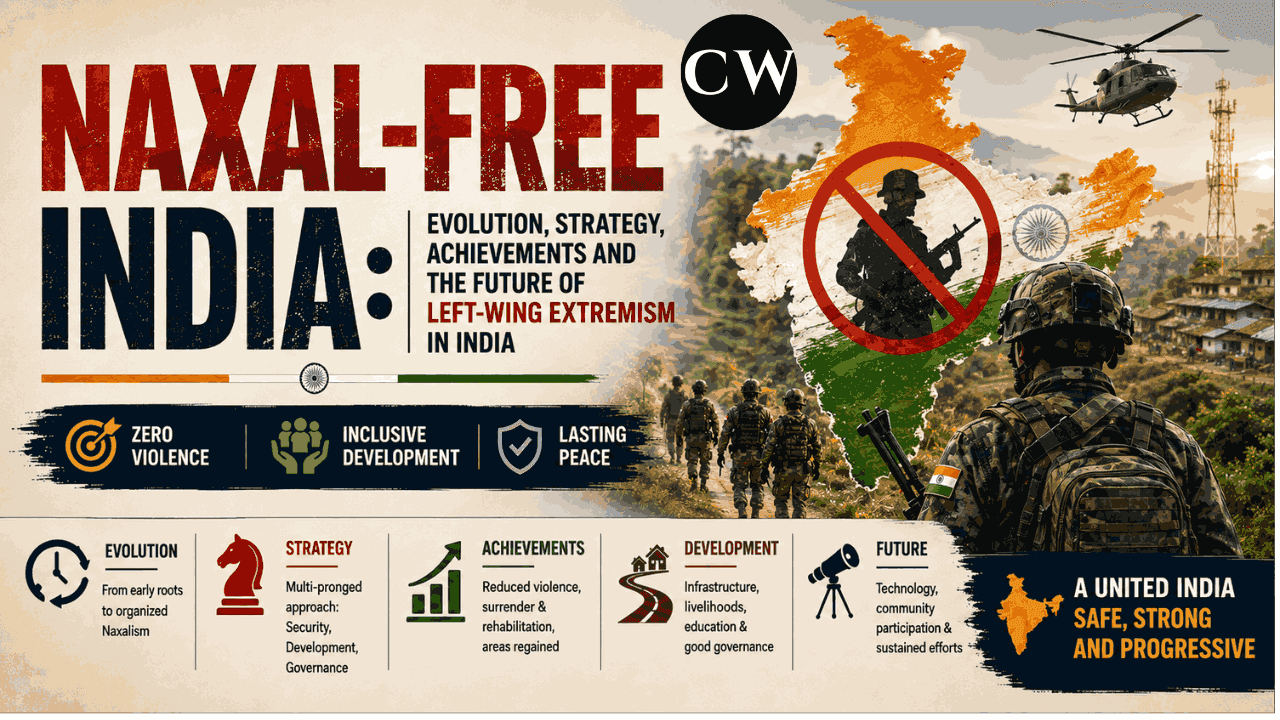
Naxal-Free India: Evolution, Strategy, Achievements and the Future of Left-Wing Extremism in India

Naxal-Free India Evolution, Strategy, Achievements and the Future of Left-Wing Extremism in India

India’s journey from the Naxalbari uprising of 1967 to becoming Naxal-free in 2026 represents one of the most remarkable achievements in the history of its internal security. This chapter provides a comprehensive understanding of Left-Wing Extremism (LWE) by examining its ideological foundations, historical evolution, causes, impact on national security, and the transformation of India’s counter-insurgency strategy. It explains how an integrated approach based on security, development, rehabilitation, and good governance successfully weakened Maoist influence while restoring peace and democratic governance in conflict-affected regions. Through detailed analysis, case studies, timelines, and practical insights, the chapter highlights the lessons India’s experience offers for addressing contemporary and future internal security challenges.

India’s Security Forces and Their Roles: CAPFs, Special Forces and Intelligence Agencies Explained

India’s Security Forces explained featuring CAPFs, Special Forces and Intelligence Agencies in India with security personnel illustration and national security theme thumbnail

Introduction Maintaining internal security and protecting national sovereignty are among the most important responsibilities of any state. In a diverse and geographically vast country like India, security challenges arise from multiple sources, including cross-border terrorism, insurgency, internal conflicts, organized crime, cyber threats, and threats to critical infrastructure. To address these challenges effectively, India has developed … Read more

Organised Crime in India: Types, Causes, Terror Nexus and Government Response | UPSC/JKAS Internal Security

Organised Crime in India – types, causes, terror nexus and government response explained for UPSC and JKAS Internal Security preparation

Introduction Organised crime has emerged as one of the most serious threats to internal security, economic stability, governance, and social order in modern societies. Unlike conventional crimes committed by individuals, organised crime involves structured criminal groups or networks that operate systematically to conduct illegal activities for profit. These criminal networks often operate across regional, national, … Read more

Border Management in India: Western, Northern, Eastern and Coastal Security Challenges | UPSC/JKAS Internal Security

Border Management in India covering Western, Northern, Eastern and Coastal security challenges for UPSC and JKAS Internal Security preparation

Introduction Border management is a crucial component of national security, territorial sovereignty, and internal stability. It refers to the comprehensive set of policies, institutional mechanisms, infrastructure, and security measures adopted by a country to protect its borders from external threats while facilitating legitimate trade and movement of people. In a country like India, which shares … Read more

Cyber Security: Types of Cyber Threats, Government Initiatives, Institutional Framework and International Conventions

Cyber security concept showing digital shield and network protection representing types of cyber threats, government initiatives, institutional framework and international conventions.

Introduction Cyber security has become one of the most critical aspects of national security, economic stability, and governance in the digital era. With the rapid expansion of digital technologies, internet connectivity, and online services, societies and governments are increasingly dependent on cyberspace for communication, financial transactions, e-governance, and critical infrastructure operations. Cyber security refers to … Read more

Communal Violence in India: Causes, Constitutional Safeguards, Major Incidents, and Way Forward | UPSC/JKAS Internal Security & Indian Society

Communal Violence in India – causes, constitutional safeguards, major incidents, and way forward explained for UPSC and JKAS Internal Security and Indian Society preparation.

Introduction Communal violence refers to violent conflicts between communities identified primarily by religion, often resulting in loss of life, destruction of property, displacement of people, and long-term social polarization. In a diverse and plural society like India—where multiple religions, cultures, and identities coexist—maintaining communal harmony is essential for national integration, social stability, and democratic governance. … Read more

Insurgency in Jammu & Kashmir: Causes, Major Militant Groups, Government Response and Current Status | UPSC/JKAS Internal Security

Insurgency in Jammu and Kashmir causes militant groups government response and current status UPSC JKAS internal security analysis

Introduction The insurgency in Jammu and Kashmir (J&K) refers to the armed separatist movement that began in 1989 against Indian administration in the region. It is one of the longest-running internal security challenges faced by India, involving militant groups seeking either independence for Kashmir or its merger with Pakistan. The conflict has been shaped by … Read more

Khalistan Insurgency in Punjab: History, Causes, Major Events and Current Status | UPSC/JKAS Internal Security

Khalistan Insurgency in Punjab – history, causes, major events and current status explained for UPSC and JKAS internal security preparation

Introduction The Khalistan insurgency refers to the separatist militant movement that emerged in the Indian state of Punjab during the late 1970s and reached its peak in the 1980s–early 1990s, demanding the creation of an independent Sikh state called Khalistan. The movement drew upon a combination of political grievances, religious identity, and regional issues, and … Read more

Insurgency in Manipur: Causes, Major Militant Groups, Ethnic Conflict and Current Status | UPSC/JKAS Internal Security Guide

Insurgency in Manipur – causes, militant groups, ethnic conflict and current security situation explained for UPSC and JKAS internal security preparation

Introduction The insurgency in Manipur represents one of the most complex and long-running internal security challenges in Northeast India. Insurgency generally refers to an organized armed rebellion against the authority of the state, often driven by political, ethnic, or socio-economic grievances. In Manipur, the insurgency has been shaped by a combination of historical grievances, ethnic … Read more

Insurgency in Meghalaya: Causes, Major Militant Groups, and Current Status | UPSC/JKAS Internal Security

Insurgency in Meghalaya – causes, major militant groups, and current status explained for UPSC and JKAS Internal Security.

Introduction The insurgency in Meghalaya forms an important component of the broader internal security challenges in Northeast India. Insurgency refers to an organized armed movement against the authority of the state, usually driven by ethnic identity, political aspirations, economic grievances, or concerns over migration and cultural preservation. In Meghalaya, the insurgency emerged primarily due to … Read more

Insurgency in Tripura: Causes, Ethnic Conflict, and Peace Process | UPSC/JKAS Internal Security Guide

Insurgency in Tripura: Causes, Ethnic Conflict, and Peace Process” for UPSC/JKAS Internal Security preparation

Introduction The insurgency in Tripura represents an important chapter in the study of internal security challenges in Northeast India. Insurgency generally refers to an organized armed movement against the authority of the state, often driven by political, ethnic, or socio-economic grievances. In Tripura, the insurgency emerged primarily due to ethnic tensions, demographic changes, land alienation, … Read more

Insurgency in Mizoram: Causes, 1966 MNF Uprising, and the Mizoram Peace Accord (1986) | UPSC/JKAS Internal Security

Insurgency in Mizoram featuring the 1966 MNF uprising, causes of insurgency, and the Mizoram Peace Accord 1986 – Internal Security topic for UPSC and JKAS preparation

Introduction The insurgency in Mizoram represents one of the most important episodes in the history of internal security in Northeast India and is widely regarded as one of the most successful examples of conflict resolution in independent India. Insurgency refers to an organized armed rebellion against the authority of the state, usually driven by political, … Read more

Insurgency in Nagaland: Historical Roots, Naga Peace Process, and Current Status | UPSC/JKAS Internal Security

UPSC/JKAS Internal Security topic explaining the insurgency in Nagaland, its historical roots, Naga peace process, and current status in Northeast India.

Introduction The insurgency in Nagaland represents one of the longest-running insurgent movements in India, making it a significant topic in the study of internal security and conflict resolution in the Northeast region. Insurgency generally refers to an organized armed rebellion against the authority of the state, often motivated by political, ethnic, or ideological objectives. In … Read more

Insurgency in Assam: Causes, Evolution, Peace Accords, and Current Status | UPSC/JKAS Internal Security

Insurgency in Assam – causes, evolution, peace accords and current status explained for UPSC and JKAS internal security preparation

Introduction Insurgency refers to an organized armed rebellion against the authority of the state, often driven by political, ethnic, ideological, or economic grievances. In India, the North-Eastern region has witnessed several insurgent movements due to its unique historical, ethnic, and geopolitical characteristics. Among the states in the region, Assam has experienced one of the most … Read more

Left Wing Extremism (Naxalism) in India: Complete Guide for UPSC/JKAS Aspirants

Left Wing Extremism (Naxalism) in India – Complete Guide for UPSC and JKAS Aspirants

Introduction Left Wing Extremism (LWE), commonly referred to as Naxalism, is one of the most significant internal security challenges faced by India. It represents an armed insurgency driven by extremist ideological groups that seek to overthrow the democratic state through violent revolutionary means. According to the Ministry of Home Affairs, Left Wing Extremism refers to … Read more

Introduction to Internal Security: Meaning, Evolution, and Significance for UPSC/JKAS Aspirants

Introduction to Internal Security: Meaning, Evolution and Significance for UPSC and JKAS aspirants

Introduction Internal security constitutes one of the most critical pillars of national security. While external security focuses on protecting a nation from foreign aggression, internal security deals with safeguarding the country from internal threats that can undermine stability, governance, and constitutional order. In a diverse and populous democracy like India, maintaining internal security is essential … Read more