Educational featured image illustrating urbanisation, environmental stress, and law and order — showing a modern city skyline with elements of pollution, greenery, and justice balance, representing the challenges of urban growth and governance.

Urbanisation, Environmental Stress, and Law & Order: Understanding the Internal Security Challenges of India’s Urban Transformation

India's rapid urbanisation is transforming its economy and society, but it also creates complex internal security challenges. Rising population density, environmental degradation, infrastructure stress, organised crime, cyber threats, and law-and-order issues have made cities increasingly vulnerable. This article explores how unplanned urban growth intersects with environmental stress and public security, examines the emerging threats facing Indian cities, and discusses policy measures, government initiatives, and sustainable urban planning strategies essential for ensuring resilient, safe, and secure urban development.
Illustration showing environmental migration and its impact on internal security — depicting displaced people, climate change effects, and national borders, symbolizing awareness of human and environmental security challenges.

Environmental Migration and Internal Security: Climate Change, Human Mobility, and National Stability

Environmental migration is emerging as one of the most significant non-traditional internal security challenges of the twenty-first century. This comprehensive guide explains how climate change, environmental degradation, and human mobility influence governance, urbanisation, resource competition, organised crime, border management, and national security. Designed for UPSC, JKPSC, JKAS, CAPF, and State PCS aspirants, this chapter provides conceptual clarity, analytical depth, government initiatives, way forward, FAQs, and a comprehensive mind map.
Educational illustration showing economic inequality and its impact on social and national stability, with contrasting wealth symbols and balanced design.

Economic Inequality and Internal Security: Understanding the Link Between Development and Stability

Economic inequality is more than a question of income or wealth—it is a critical determinant of social cohesion, democratic stability, and internal security. This chapter examines how unequal access to opportunities, regional disparities, unemployment, and governance deficits can gradually weaken public trust, create social alienation, and provide opportunities for organised crime, extremist groups, and anti-state actors to exploit public grievances. Through conceptual analysis, Indian and international case studies, intelligence perspectives, government initiatives, and emerging challenges, the chapter demonstrates that inclusive development is not merely an economic objective but a strategic investment in national security. It equips aspirants with a comprehensive understanding of how development and security reinforce one another in a modern democratic state.
Professional featured image showing digital security icons and a national network map, representing data protection, data sovereignty, and national security concepts.

Data Protection, Data Sovereignty, and National Security: Safeguarding India’s Digital Future in the Information Age

In the digital age, data has emerged as one of the most valuable strategic assets, influencing governance, economic development, technological innovation, and national security. This chapter explores the concepts of Data Protection and Data Sovereignty, examines how data can be weaponised through cyber espionage, disinformation, and cyberattacks, and analyses India's legal, institutional, and policy framework for securing digital information. It also discusses key challenges, government initiatives, real-world case studies, and the way forward for building a secure, trusted, and sovereign digital ecosystem. Designed for UPSC, JKPSC, JKAS, and other competitive examinations, the chapter provides a comprehensive understanding of one of the most critical dimensions of contemporary internal security.

Abstract digital background illustrating the weaponisation of technology — depicting data networks, AI graphics, and cybersecurity locks in a professional, academic style.

Weaponisation of Technology and Its Security Implications: Understanding Emerging Threats in the Digital Age

The rapid advancement of emerging technologies has transformed the nature of warfare and internal security, creating new opportunities as well as unprecedented risks. Technologies such as artificial intelligence, drones, autonomous systems, cyber weapons, deepfakes, biotechnology, and quantum computing are increasingly being weaponised by state and non-state actors. This article explores how the weaponisation of technology is reshaping India's security landscape, examines the evolving threats to national security and public safety, analyses the legal and policy responses, and discusses strategies for building a resilient, technology-driven security framework in the digital age.
A professional digital illustration symbolizing the balance between government surveillance and personal privacy, showing technology elements like data streams, security cameras, and digital icons representing civil liberties.

Balancing Surveillance and Civil Liberties in a Digital State

As India rapidly embraces digital governance, technologies such as facial recognition, CCTV networks, artificial intelligence, and digital databases have significantly enhanced the state's ability to prevent crime and strengthen internal security. However, these advancements also raise critical concerns about privacy, data protection, surveillance overreach, and civil liberties. This article examines the delicate balance between national security and individual rights, analyses India's legal and constitutional framework, explores emerging challenges in the digital age, and highlights the way forward for ensuring accountable, transparent, and rights-based surveillance.
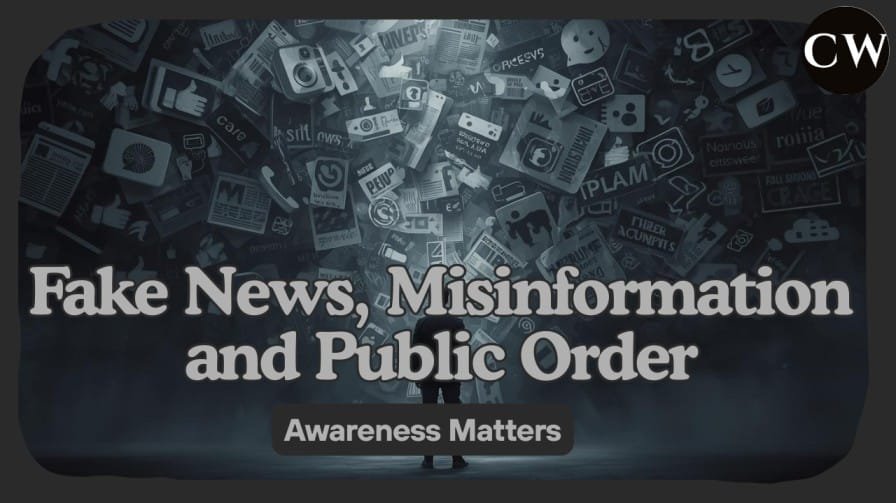
A serious educational illustration showing digital misinformation spreading across media channels, symbolizing the societal impact of fake news and its influence on public order.

Fake News, Misinformation, and Public Order: Managing Information Disorder in the Digital Age

In the digital age, information has become a strategic asset capable of shaping public opinion, influencing political outcomes, and affecting national security. The rapid expansion of social media, encrypted messaging platforms, and artificial intelligence has enabled false information to spread at unprecedented speed, often outpacing verification and official communication. As a result, fake news, misinformation, disinformation, and malinformation have evolved from isolated communication problems into significant internal security challenges.