
Introduction
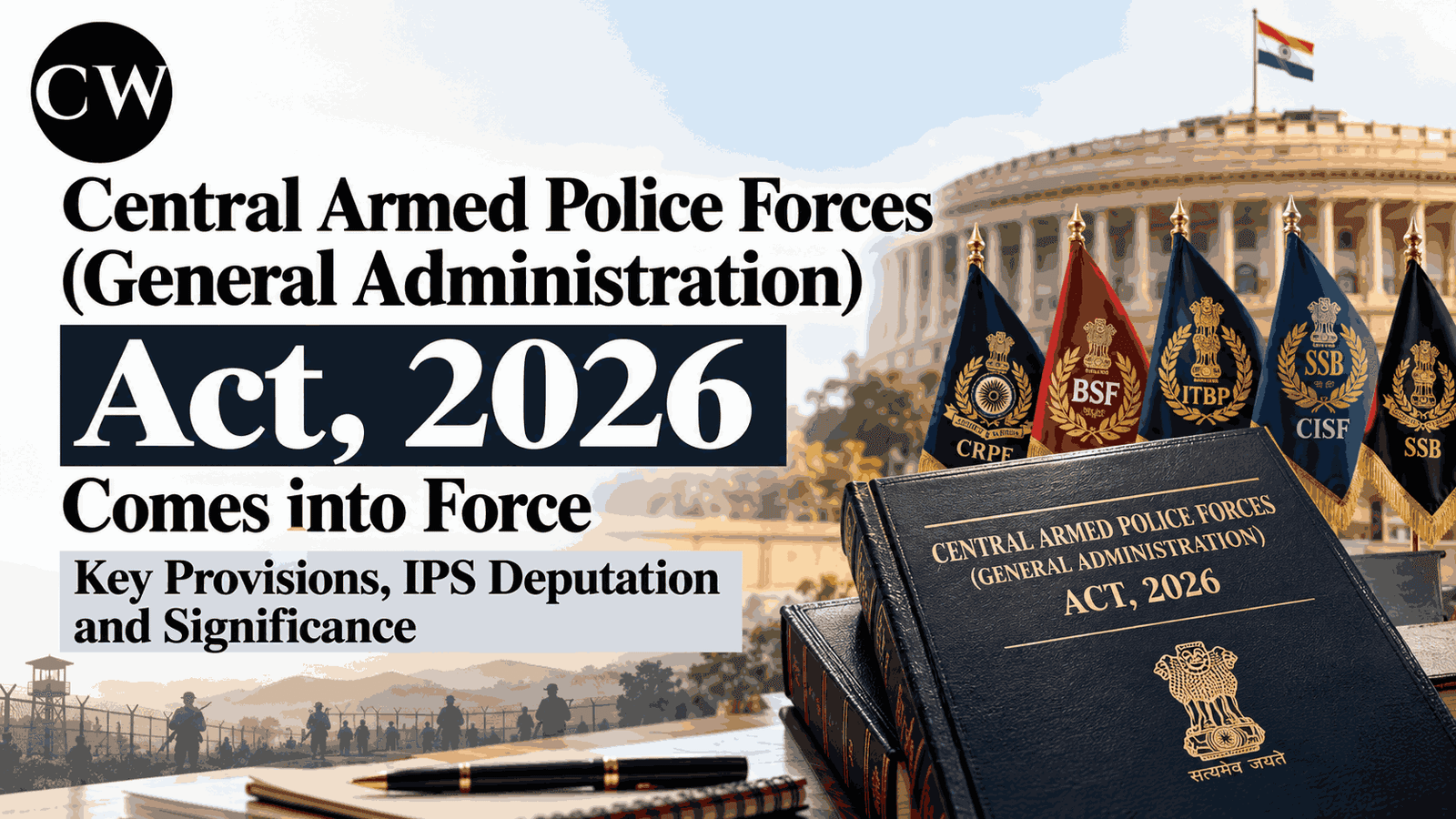
The Central Armed Police Forces General Administration Act 2026 came into force on 8 October 2026. Additionally, it changes recruitment and service conditions for Group A General Duty officers and other CAPFs. Moreover, the Union Ministry of Home Affairs notified 8 October as the commencement date for the provisions. President Droupadi Murmu gave assent on 9 April 2026, but the commencement was left to a subsequent notification.
The significance of the legislation goes beyond the creation of another administrative law. Moreover, it establishes a framework for recruitment, promotion, deputation and service conditions in five CAPFs—CRPF, BSF, CISF, ITBP and SSB.
Additionally, it gives the Central Government broad rule-making powers. It creates a statutory framework for deputation of Indian Police Service (IPS) officers to senior CAPF positions. Moreover, this has become significant as the Act follows a major Supreme Court judgment on CAPF career progression. It also addresses the ongoing reduction of IPS deputation in these forces.
The development therefore needs to be understood through three connected questions: why a new umbrella law was considered necessary. The second question is what the Act actually changes. Moreover, it explains how its provisions interact with the existing institutional and judicial framework governing CAPFs.
Learning Dashboard
| What you will learn | Why it matters | What you should understand |
|---|---|---|
| What the CAPF (General Administration) Act, 2026 is | Establishes the basic legal framework | Its purpose and scope |
| Why the legislation was introduced | Explains the administrative and institutional background | The problem of fragmented service rules |
| CAPFs covered by the Act | Prevents confusion about its present scope | CRPF, BSF, CISF, ITBP and SSB |
| Rule-making powers of the Central Government | Central to understanding the Act’s operation | How recruitment, promotion and deputation can be regulated |
| IPS deputation provisions | One of the most consequential provisions | 50% IG, minimum 67% ADG and all DG/SDG posts through deputation |
| Supreme Court background | Explains the larger legal context | The relationship between judicial directions and legislation |
| Significance and concerns | Enables balanced analysis | Career progression, operational requirements and separation of powers |
| Current position | Prevents confusion between enactment and commencement | The Act is in force from 8 October 2026 |
What is the Central Armed Police Forces (General Administration) Act, 2026?
The Act is Act No. 9 of 2026. Its stated purpose is to regulate the general rules governing the recruitment and conditions of service of Group A General Duty Officers and other officers in the Central Armed Police Forces, along with other rules concerning these forces. The legislation describes the CAPFs as armed forces of the Union performing important national-security functions, including border security and internal-security responsibilities.
The Act was enacted against a background in which recruitment and service conditions for CAPF officers were governed primarily through rules made under the individual legislation governing different forces. The new framework seeks to provide greater uniformity and legislative clarity while preserving what the law describes as the operational distinctiveness of the CAPFs.
This is why the legislation is better understood as an umbrella administrative and service-law framework rather than as a law creating a new CAPF.
Which CAPFs are covered?
The First Schedule of the Act presently identifies five Central Armed Police Forces through their respective parent Acts:
| CAPF | Parent legislation listed in the Act |
|---|---|
| Central Reserve Police Force (CRPF) | Central Reserve Police Force Act, 1949 |
| Border Security Force (BSF) | Border Security Force Act, 1968 |
| Central Industrial Security Force (CISF) | Central Industrial Security Force Act, 1968 |
| Indo-Tibetan Border Police (ITBP) | Indo-Tibetan Border Police Act, 1992 |
| Sashastra Seema Bal (SSB) | Sashastra Seema Bal Act, 2007 |
The Act also allows the Central Government to add another Union armed force to the First Schedule by notification, subject to the statutory procedure. Therefore, the present statutory scope should not automatically be described as covering every organization that may popularly be called a “CAPF.”
This distinction is important because “CAPF” is often used loosely in public discussion, whereas the Act itself defines its scope through the statutes listed in its Schedule.
Why was an umbrella law considered necessary?
Before the 2026 legislation, service conditions and recruitment arrangements for the different CAPFs were governed through their respective Acts and recruitment rules. That arrangement reflected the separate historical development of the forces, but it could also produce differences in service structures and administrative rules.
The legislation therefore attempts to establish a common legal framework for matters such as recruitment, promotion, deputation and conditions of service while retaining the individual force-specific rules listed in the Second Schedule until they are modified, amended, rescinded or superseded.
The deeper institutional issue is that CAPFs perform national functions but operate in close coordination with State authorities. The Act’s statement of objects and provisions therefore connect administrative uniformity with operational requirements, Centre-State coordination and the distinct command structure of armed forces.
In other words, the legislation attempts to solve two problems simultaneously:
fragmented service regulation and the need for a common framework suited to the operational character of CAPFs.
What does the Act actually regulate?
One of the central provisions is the Central Government’s power to make rules concerning the method, manner and mode of recruitment, including promotion and deputation, as well as conditions of service of officers in the covered CAPFs.
The Act gives these rules overriding effect where they are inconsistent with another law, rule or government order. It also states that the Act itself will have effect notwithstanding anything inconsistent with it in another law or instrument having legal effect.
At the same time, the legislation does not immediately discard every existing recruitment rule. The Second Schedule preserves specified existing Group A General Duty recruitment rules unless and until they are modified, amended, rescinded or superseded.
This creates an important transition mechanism:
Existing recruitment rules → continued operation → Central Government rule-making → modification/supersession where required
That is significant because it allows the new statutory framework to operate without creating an immediate administrative vacuum.
The most significant provision: IPS deputation
The most consequential and debated feature of the Act concerns the appointment of IPS officers to senior positions in the covered CAPFs.
Section 3 provides that rules concerning appointment of IPS officers in the rank of Inspector General and above must provide for:
- 50% of Inspector General posts to be filled through deputation;
- at least 67% of Additional Director General posts to be filled through deputation;
- all Special Director General and Director General posts to be filled through deputation.
This creates a statutory framework for IPS deputation at senior levels rather than leaving the matter entirely to individual administrative arrangements.
The provision is particularly important because the issue of IPS deputation has been at the center of a longer dispute concerning the career progression and cadre structure of CAPF officers.
The Supreme Court background
The significance of the 2026 Act cannot be understood without considering the Supreme Court’s intervention in the CAPF cadre issue.
In its 23 May 2025 judgment in Sanjay Prakash and Others v. Union of India and Others, the Supreme Court dealt with issues concerning the status of CAPFs as organized Group A services, cadre-related matters and the deputation of IPS officers. The litigation arose partly from concerns of CAPF cadre officers regarding promotional opportunities and the effect of deputation on their career progression.
The Court directed that deputation of IPS officers in CAPF cadres up to the Senior Administrative Grade should be progressively reduced over time. The broader objective was connected with cadre review, promotional opportunities and the recognition of CAPF officers’ service structure.
This created a significant institutional question.
Judicial direction → progressive reduction of deputation
was followed by
Parliamentary legislation → statutory provisions prescribing substantial IPS deputation at senior ranks
That interaction is one of the most important constitutional and administrative dimensions of the 2026 Act.
Why is the issue legally significant?
The Act does not merely alter administrative practice. It creates a statutory basis for rules concerning recruitment and service conditions and expressly provides that rules made under the Act can operate notwithstanding inconsistent laws, judgments, decrees, orders or government orders.
This raises an important constitutional-law question: to what extent can Parliament establish a new statutory framework after a court has interpreted the existing legal and service framework?
The answer cannot be reduced to the simplistic proposition that either “Parliament overruled the Supreme Court” or “the Court automatically invalidates the new law.” The constitutional position depends on the distinction between:
judicial interpretation of existing law and legislative alteration of the legal framework itself.
A legislature cannot simply declare a binding judicial decision void, but Parliament can, within constitutional limits, change the underlying legal framework on which a judicial decision was based. Whether a particular statutory provision validly achieves that result is ultimately a matter for constitutional adjudication.
This distinction is especially important for examination purposes.
Current judicial context
The legislation has become part of continuing litigation concerning CAPF cadre management and IPS deputation.
In September 2026, the Supreme Court was examining compliance with its 2025 directions and sought an explanation from the Ministry of Home Affairs concerning the deputation of 46 IPS officers to the five CAPFs after the May 2025 judgment.
The subsequent proceedings also involved challenges concerning the validity of the 2026 Act. As of October 2026, the legal dispute therefore remains an evolving area rather than a closed question. Reports indicate that connected matters concerning the Act and implementation of the earlier judgment are scheduled before the Supreme Court in October.
Accordingly, the correct current position is:
The Act is in force, but questions surrounding its interaction with earlier judicial directions and ongoing litigation remain subject to judicial consideration.
That distinction is essential. Commencement of an Act does not mean that every constitutional challenge to its provisions has been finally resolved.
What changed on 8 October 2026?
There are three dates that should not be confused:
| Stage | Date | Significance |
|---|---|---|
| Bill introduced in Rajya Sabha | 25 March 2026 | Legislative process began |
| Presidential assent | 9 April 2026 | Bill became an Act |
| Commencement | 8 October 2026 | Act’s provisions came into force |
The President’s Secretariat records presidential assent on 9 April 2026. The enacted law itself provided that it would come into force on a date appointed by the Central Government through notification. The Union Government subsequently appointed 8 October 2026 as the commencement date.
Therefore, the statement “the Act came into force on 8 October 2026” is correct.
But saying that “the President gave assent on 8 October 2026” would be incorrect.
This is precisely the kind of distinction that matters in legal and constitutional current affairs.
Institutional significance
The Act has several broader implications for India’s security administration.
First, it creates a common statutory framework across five major CAPFs. This may reduce the fragmentation that can arise when similar service matters are governed by separate institutional legislation and recruitment rules.
Second, it gives the Central Government substantial authority to frame and modify rules relating to recruitment, promotion and deputation. The rules therefore become a central mechanism through which the statutory framework will operate in practice.
Third, the Act formalizes the role of IPS officers in senior CAPF leadership by prescribing minimum levels of deputation at specified ranks. This makes the relationship between the All India Service structure and the dedicated CAPF cadres a statutory issue rather than merely an administrative arrangement.
Fourth, the legislation brings the question of operational command versus cadre progression into sharper focus. CAPFs require coordinated leadership across Union and State security structures, while their own Group A officers have an institutional interest in meaningful promotional progression within their cadres.
The policy challenge is therefore not simply “IPS versus CAPF officers.” It is a broader question of how India should balance:
operational coordination + specialized CAPF experience + career progression + cadre management + institutional accountability.
What does the Act mean for CAPF cadre officers?
For CAPF Group A officers, the issue is closely connected with promotional avenues and senior-level career progression.
The Act defines a Group A General Duty Officer as a Group A general duty or executive officer of the rank of Assistant Commandant and above. It also recognizes IPS officers on deputation, Army officers on deputation or re-employment, and other officers recruited under the specified rules within the definition of “officer.”
The practical effect of the Act will therefore depend not only on the text of the statute but also on:
- rules framed under it;
- cadre reviews;
- recruitment rules;
- deputation arrangements;
- implementation by the Ministry of Home Affairs;
- and the outcome of pending judicial proceedings.
This is why the Act should not be understood as a single administrative event that immediately resolves every CAPF cadre issue.
Why does the Act matter for Internal Security?
CAPFs are central to India’s internal-security architecture.
Different forces perform different operational roles, including:
- internal security and counter-insurgency;
- border guarding;
- industrial and critical-infrastructure security;
- high-altitude border duties;
- and security responsibilities along India’s international borders.
Their operational environment requires both specialized force-level expertise and coordination with the Union Government, State police and other security institutions.
The Act’s attempt to create a common administrative framework therefore has significance beyond personnel management. Personnel policy affects institutional capacity.
Recruitment rules determine entry.
Promotion rules influence career progression.
Deputation rules determine leadership composition.
Cadre management influences institutional continuity.
Leadership structure affects operational command.
Thus: Service rules → Cadre structure → Leadership → Institutional capacity → Security effectiveness
This is the broader governance significance of the legislation.
Critical analysis
The Act has a clear institutional rationale: five major CAPFs require a coherent framework for regulating senior officers and service conditions. A common framework can potentially improve administrative consistency and provide the Central Government with greater flexibility to respond to operational requirements.
At the same time, the statutory prescription for IPS deputation at senior levels creates a significant tension with the concerns that had been raised in the Supreme Court litigation regarding career progression within the dedicated CAPF cadres.
The key analytical issue is therefore institutional balance.
A system that relies too heavily on external deputation may affect the promotional pipeline and institutional experience of cadre officers. Conversely, the government may argue that CAPFs operate in a national and inter-State security environment where coordination with State police and the broader policing system requires experienced IPS leadership. The legislation reflects the latter institutional approach by prescribing substantial IPS representation at senior ranks.
The ultimate significance of the Act will therefore depend on how the statutory provisions, subordinate rules, cadre reviews and judicial decisions interact in practice.
What aspirants should remember
For UPSC, State PSC and other competitive examinations, the most important facts are not simply the name and date of the Act. Candidates should understand the relationship between CAPF administration, deputation, cadre management, Parliament and judicial review.
Key points include:
- The legislation is the Central Armed Police Forces (General Administration) Act, 2026.
- It is Act No. 9 of 2026.
- Presidential assent was given on 9 April 2026.
- It came into force on 8 October 2026.
- It currently covers CRPF, BSF, CISF, ITBP and SSB through the First Schedule.
- It regulates recruitment and conditions of service of Group A General Duty officers and other officers.
- The Central Government is empowered to frame rules concerning recruitment, promotion and deputation.
- 50% of IG posts are to be filled through IPS deputation.
- At least 67% of ADG posts are to be filled through IPS deputation.
- SDG and DG posts are to be filled through deputation.
- Existing specified recruitment rules continue unless modified or superseded.
- The Act has become part of a broader legal debate concerning the Supreme Court’s 2025 CAPF cadre directions.
Prelims Perspective
A likely conceptual trap is to confuse assent with commencement.
Assent ≠ commencement.
The President’s assent completed the constitutional legislative process for the Bill to become an Act, while Section 1(2) left commencement to a separate Central Government notification.
Another trap is to assume that the Act automatically covers every force popularly described as a CAPF. The present First Schedule specifically lists five forces: CRPF, BSF, CISF, ITBP and SSB.
A third trap is to confuse the percentages:
IG → 50%
ADG → minimum 67%
SDG/DG → 100%
These provisions concern IPS officers on deputation.
Revision Zone
| Area | Key fact |
|---|---|
| Act | Central Armed Police Forces (General Administration) Act, 2026 |
| Act Number | 9 of 2026 |
| Assent | 9 April 2026 |
| Commencement | 8 October 2026 |
| Ministry | Ministry of Home Affairs |
| Presently covered | CRPF, BSF, CISF, ITBP, SSB |
| Group A General Duty Officer | Assistant Commandant and above |
| IG deputation | 50% |
| ADG deputation | Minimum 67% |
| SDG/DG | Deputation only |
| Main purpose | Recruitment and service conditions framework |
| Important background | CAPF cadre and IPS deputation dispute |
| Current status | Act in force; related judicial issues remain under consideration |
FAQs
Is the Central Armed Police Forces (General Administration) Act, 2026 in force?
Yes. The Central Government appointed 8 October 2026 as the date on which the Act’s provisions came into force.
When did President Droupadi Murmu give assent to the Act?
The President gave assent on 9 April 2026.
Which CAPFs are currently covered by the Act?
The First Schedule currently lists CRPF, BSF, CISF, ITBP and SSB.
What is the major provision concerning IPS officers?
The Act provides for 50% of IG posts, at least 67% of ADG posts, and all SDG and DG posts to be filled through IPS deputation.
Does the Act immediately abolish existing CAPF recruitment rules?
No. The Act provides that specified existing Group A General Duty recruitment rules continue until they are modified, amended, rescinded or superseded.
Why is the Act linked to the Supreme Court’s CAPF judgment?
The legislation was enacted against a background of litigation concerning CAPF cadre status, career progression and IPS deputation. The Supreme Court’s May 2025 judgment directed progressive reduction of deputation in CAPF cadres, making the subsequent statutory framework particularly significant.
Relationship & Causal Map
Separate CAPF Acts + Different Service Rules
                    │
                    ↓
        Fragmented Administrative Framework
                    │
                    ↓
     Cadre / Promotion / Deputation Issues
                    │
                    ↓
      Supreme Court Intervention (2025)
                    │
          ┌─────────┴─────────┐
          ↓                   ↓
   CAPF cadre concerns    IPS deputation issue
          │                   │
          └─────────┬─────────┘
                    ↓
       Parliament enacts CAPF
       (General Administration) Act, 2026
                    │
                    ↓
       Common statutory framework
                    │
          ┌─────────┼─────────┐
          ↓         ↓         ↓
     Recruitment  Promotion  Deputation
                              │
                              ↓
                    IPS senior-post framework
                    │
          ┌─────────┼─────────┐
          ↓         ↓         ↓
        IG 50%    ADG ≥67%   SDG/DG 100%
                    │
                    ↓
          Act commences 8 Oct 2026
                    │
                    ↓
       Current implementation + litigation
                    │
                    ↓
      Future rules + cadre review + judicial
                 determination
Current Position — October 2026
The Central Armed Police Forces (General Administration) Act, 2026 is now in force from 8 October 2026. Its presidential assent dates to 9 April 2026. The Act currently establishes an umbrella framework for five specified CAPFs and contains statutory provisions governing senior-level IPS deputation. The interaction between the new statute, CAPF cadre interests and earlier Supreme Court directions remains an important developing legal issue.